When scientific research tackles complex pathologies, the goal of bioactive compounds is not to cure, but to protect the cellular environment. An analysis of independent studies.
Nutraceuticals are meant to support oncological treatments, never to replace them.
Let’s make this clear from the very first line. When medical science addresses complex pathologies like breast cancer, the role of premium bioactive compounds is not to cure, but to foster biological resilience. This means providing cells with a system of protection and stability to withstand the often devastating impact of traditional medical protocols.
In this scenario, Hydroxytyrosol is emerging as a key player. It is a small, highly stable molecule with exceptional bioavailability, now at the center of rigorous clinical and preclinical studies conducted by independent research bodies for its extraordinary ability to modulate tissue stress.
What emerges from the analysis of scientific data?
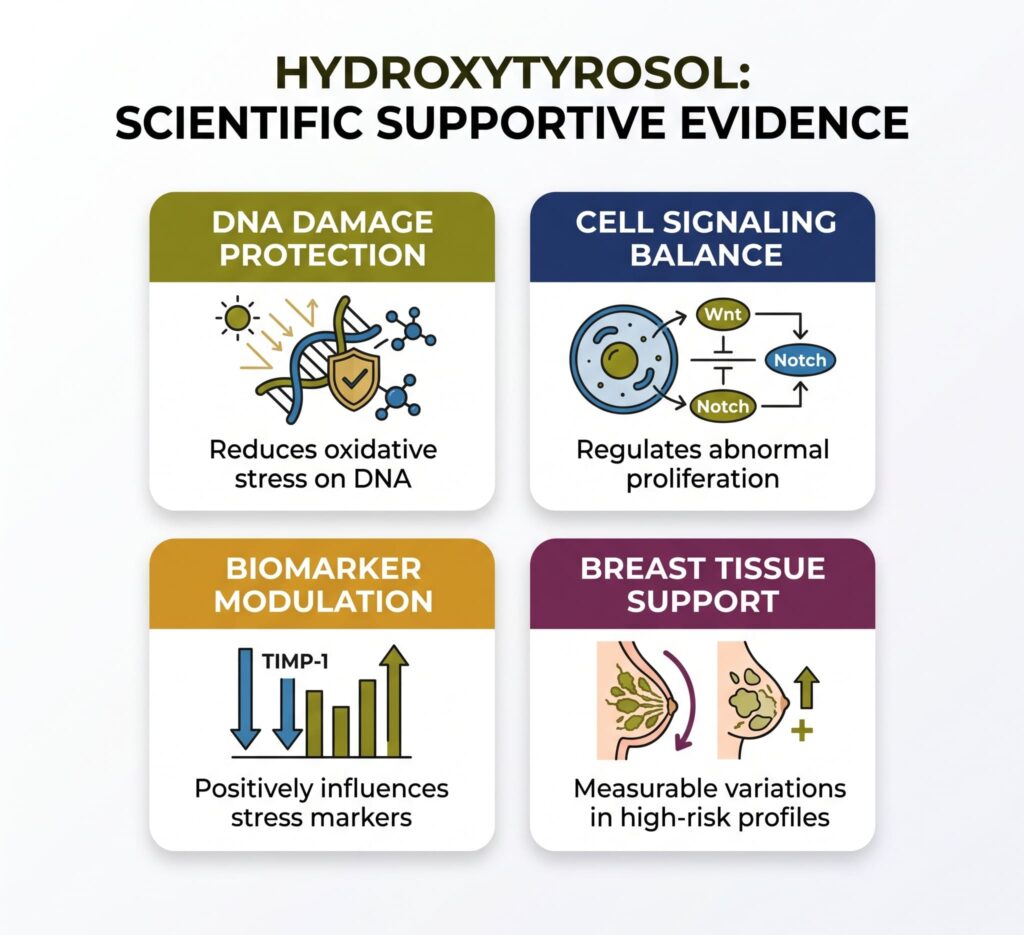
The results of independent studies provide a clear picture of Hydroxytyrosol’s supportive dynamics, highlighting four fundamental areas of biological intervention:
1. A shield against DNA damage
In preclinical settings, Hydroxytyrosol has proven that it doesn’t act randomly, but in a highly targeted manner. Its primary goal is to reduce the oxidative load, recognized by the scientific community as one of the main triggers for deep cellular damage. Reducing this stress means preserving DNA integrity.
2. Modulation of cellular signaling pathways
Hydroxytyrosol exhibits a marked ability to interact with key cellular signaling pathways (such as the Wnt and Notch pathways). This intervention supports the structural and functional stability of the healthy cell, while simultaneously counteracting abnormal proliferation dynamics.
3. Positive impact on stress biomarkers
Moving to clinical evidence, data indicate that targeted supplementation can positively influence specific stress-related biomarkers, such as TIMP-1, especially during chemotherapy cycles. This translates into excellent biological support for a body weakened by treatment.
4. Active support in high-risk profiles
One of the most promising aspects concerns active prevention. In women with high breast density (a known risk factor), Hydroxytyrosol induced measurable biological variations. This confirms it not just as a simple supplement, but as a top-tier nutritional and protective strategy.
FENÒLIA®’s commitment: from research to absolute purity
The data we have analyzed do not in any way constitute an alternative oncological treatment, but they do certify undeniable and invaluable nutraceutical support.
At FENÒLIA®, we simply translate this scientific evidence into pure, fully traceable, and biologically active formulations. Our products are designed exclusively with one goal in mind: to protect and sustain the cellular environment precisely when it is subjected to the most extreme stress.
Bibliography and Independent Sources
For the sake of complete transparency and scientific outreach, below are the full studies referenced in this article.
Hydroxytyrosol inhibits cancer stem cells and the metastatic capacity of triple-negative breast cancer cell lines by the simultaneous targeting of epithelial-to-mesenchymal transition, Wnt/β-catenin and TGFβ signaling pathways:
Read the full paper
Hydroxytyrosol Counteracts Triple Negative Breast Cancer Cell Dissemination via Its Copper Complexing Properties:
Read the full paper
Hydroxytyrosol, a Component of Olive Oil for Breast Cancer Prevention in Women at High Risk of Cancer:
Read the full paper
Hydroxytyrosol, Tyrosol and Derivatives and Their Potential Effects on Human Health (FENÒLIA® is featured in the official bibliography of this study at no. 31).:
Read the full paper